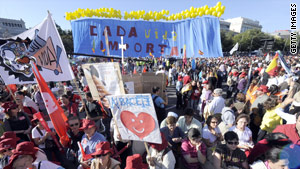
 Photo: "Every Life Matters" protest by a million Spaniards concerning the controversial abortion bill
Recently in Spain there has much debate over the abortion laws. Most recently a new law approved by parliament and sent to senate that has been widely opposed by some. It would make the current law less strict. And there is talk of a future law that would require medical students to learn the procedure.
I personally agree with the quote below that it is not a question of politics but of humanity. In the western world we are so often concerned over the rights of animals and human rights, but the rights of an unborn child are ignored and seen as just a mass of unwanted flesh. Somehow at 22 weeks, or 8 months, I think it would be hard for anyone to deny the fact that it is a baby in the womb (particularly if it could survive outside of the womb) and yet he or she can still be aborted. And, for the argument about the woman's rights, all the women I know who have had an abortion would attest to the fact that women who abort suffer physically and psychologically and for years after the fact.
Anyway, I know this is an extremely polemic issue. Here are some snippets from new articles from this past year and below are some full articles (all from CNN, NYTimes, and BBC News).
"The current law allows terminations in the first 12 weeks of pregnancy only in cases of rape and in the first 22 weeks in cases of congenital disorder. However, a woman can abort at any time if her mental or physical health is at risk — an exception cited in about 97 percent of abortions in Spain, according to Empar Pineda, spokeswoman for the Spanish Association of Accredited Abortion Clinics."
"The new law in Spain, which the government is in the process of drafting, would make abortion available on request in the first 14 weeks, and it would allow women as young as 16 to seek one without parental consent. Also under the law, a woman could abort in the first 22 weeks in the case of congenital disorder and after that if continuing the pregnancy put her life at risk."
"“We truly cannot give in to this,” he said of the new legislation. “It is not a question of politics, it is a question of humanity.”
The Spanish Episcopal Conference has rented billboards in three dozen cities on which they displayed a protected Iberian lynx next to a crawling baby with the words, “What about me? Protect my life.”
Anti-abortion groups and conservative regional governments have joined the protest. The regional government of Valencia, led by the Popular Party, is preparing an anti-abortion law that would, among other things, promote a network of surrogate families who would take in or support single mothers-to-be.
Thousands of people in Spain and Latin America turned out on March 29 for a protest organized by HazteOir, a conservative advocacy group. The group’s president, Ignacio Arsuaga, said the government should enforce the existing law rather than loosen it.
“This government likes to say it defends women’s rights,” he said by telephone. “But women who abort suffer physically and psychologically.”
"Abortion is carried out by a medical practitioner in a public or private clinic with the express consent of the pregnant woman under the following circumstances:
1. To avoid physical or mental harm to the mother (in this case two specialists must consent to the abortion going ahead)
2. If the pregnancy is the result of rape or an act of incest that has been declared to the police. The abortion must however be carried out within the first 12 weeks.
3. If the baby is severely physically or mentally handicapped. The abortion must again take place within the first 22 weeks. In this instance two specialists from an approved health centre plus the doctor in charge must certify that the foetus will suffer from its severe defects if allowed to be born.
4. In the case of an emergency that puts the life of the mother at risk, the abortion may be carried out without the express consent of the doctor and without that of the mother.
All voluntary interruptions of pregnancy carried out in conformity with Organic Law No. 9 of 1985 must be reported to the Spanish national health authorities by the Ministry of Health of each Autonomous Community on receipt of a form filled out by the doctor performing the abortion. The woman is not required to supply her name.
If one of these four circumstances exists, the Spanish Social Security (National Health Care) will pay for the termination.""
SEVERAL NEW ARTICLES - PRESENT & PAST
Spanish Parliament approves abortion bill -By Al Goodman, CNN Madrid Bureau Chief, December 17, 2009 11:24 a.m. EST
Madrid, Spain, (CNN) -- The Spanish Parliament approved a controversial bill on Thursday to make it easier to get an abortion in Spain, and sent it to the Senate.
The ruling Socialists and smaller-party allies amassed 184 votes against 158 from the main opposition conservative Popular Party and its allies.
Since 1985, abortion has been decriminalized in Spain, but only in matters of rape, or when the health of the child or mother is at risk.
Abortions have doubled in the past decade in the traditionally Roman Catholic country, from nearly 54,000 in 1998 to 112,000 in 2007, the most recent year for available data, according to Spain's Ministry of Health.
The Roman Catholic church here and the main opposition conservative Popular Party have blasted the government's bill to make it easier to get an abortion and give it legal backing.
The bill would permit abortions through 14 weeks of pregnancy, with few questions asked. But the most controversial section, according to many politicians and analysts, was a Socialist proposal to permit abortions for 16-year-olds without prior consent from their parents.
In recent negotiations to win enough votes, the Socialists agreed to soften that proposal. The version approved on Thursday would require 16 year-olds to get prior consent from their parents, unless such notification is reasonably considered to create a potentially violent conflict within the family.
Tens of thousands of people marched last October in Madrid against the abortion bill, under the theme "each life is important." Many leading conservative politicians attended, including former Prime Minister Jose Maria Aznar.
They say the proposed law throws open the door to more abortions. A protest organizer, Benigno Blanco, told the crowd "this debate won't end until there's not a single abortion." Blanco was a senior official in Aznar's government.
But the bill's supporters say the abortion measures are part of a broader national strategy on sexual and reproductive health, including education and access to contraceptives, which aims to prevent unwanted pregnancies in Spain.
The Socialists have called the conservatives "hypocritical," accusing them of doing nothing to completely outlaw abortion during their eight years in power from 1996 to 2004.
 A group of women shout and hold placards as they take part in a protest march to oppose the government's
Spain's drops controversial abortion measure - AFP, Thu Dec 10, 1:26 pm ET
MADRID (AFP) – Spain's ruling Socialist Party agreed on Thursday to amend the most controversial of its abortion reforms, one that would have allowed girls of 16 to end a pregnancy without parental consent.
The measure had been condemned by both the conservative opposition Popular Party as well as some Socialist lawmakers.
At the demand of the centre-right Basque Nationalist Party (PNV), parliament's Equal Opportunities Committee on Thursday approved a new version of the law that does not include the measure, political sources said.
However, the new legislation would still allow girls of 16 and over to undergo abortions without their parents' consent if there is "certain danger of family violence, threats, pressure, abuse, family exclusion or distress."
The new version of the proposed law would also allow doctors to refuse to carry out the procedure if they register as "conscientious objectors" to abortion.
The PNV said it would vote in favour of the bill "as its demands have been incorporated."
Spanish Prime Minister Jose Luis Rodriguez Zapatero governs without an absolute majority and relies on the support of smaller parties such as the PNV in order to pass legislation.
Zapatero's cabinet approved the draft law at a cabinet meeting in September despite strong opposition from the Roman Catholic Church and the PP.
Hundreds of thousands of people took to the streets of Madrid on October 17 to condemn the measures in a demonstration organised by the Spanish Family Forum, a coalition of Catholic groups.
Under the reforms, abortions would be allowed on demand up to the 14th week of pregnancy, and up to 22 weeks if there is a risk to the mother's health or if the foetus is deformed.
Women could also undergo the procedure after 22 weeks if the foetus has a serious or incurable illness.
The existing law, introduced in 1985, a decade after the death of right-wing dictator Francisco Franco, only allows abortion in cases of rape, foetal malformation and when a pregnant woman's mental or physical health is deemed to be at risk if the pregnancy goes to term.
PAST ARTICLES
Big anti-abortion rally in Spain
Pro-life protesters turned out in numbers
Saturday, 17 October 2009 22:42 UK - BBC News
More than a million people are said to have taken part in a march in Madrid to oppose government plans to liberalise Spain's abortion law.
Several dozen centre-right opposition party joined the demonstration, which was backed by Roman Catholic bishops.
Socialist Prime Minister Jose Luis Rodriguez Zapatero wants to introduce abortion on demand.
At present, a pregnancy can only be terminated in mainly Catholic Spain under specific circumstances.
The government wants the procedure to be available to all women up until the 14th week of pregnancy.
Most controversially, the draft law currently before parliament would also permit girls aged 16 and 17 to have an abortion without their parents' knowledge.
It is the latest in a series of ethical issues which have pitted the Catholic right against the government, which has legalised gay marriage and made divorce easier.
Police estimates put the crowd at 250,000, but the regional government said that over a million had turned out, with the organisers claiming a turnout of two million.
'Every life matters'
The march brought together more than 40 religious and civil society groups calling for the government to withdraw the draft bill.
"This new law is a barbarity," said one protester, Jose Carlos Felicidad, from the southern town of Algeciras.
"In this country, they protect animals more than human beings," he told AFP news agency.
A broad cross-section of Spanish society were represented, says the BBC's Steve Kingstone in Madrid - old and young, parents with babies, priests, nuns, immigrant families and organised groups coached in from all over the country.
They gathered in the heart of Madrid under an enormous blue banner the height of a two-storey building emblazoned with the simple message: "Every life matters."
The crowd stretched all the way up the city's main avenue.
The demonstrators would have been hoping that lawmakers at the parliament nearby were listening, our correspondent adds, because it is they who in due course will vote on this controversial legislation.
Respect and rights?
Spain's existing law, dating from 1985, allows abortion in cases of rape and when there are signs of fetal abnormality.
Spanish women can also end a pregnancy if their physical or psychological health is at risk. In practice, the last category has been used to justify the vast majority of abortions - of which there were 112,000 in 2007.
The government says the new law is about respect and rights for women, and that anyone wanting to terminate a pregnancy will first be explained the alternatives - including state help for young mothers.
It also claims its proposal will make abortion safer - by ensuring the procedure does not happen beyond 22 weeks of a pregnancy.
In recent years shocking cases have emerged in which doctors performed abortions on women eight months pregnant, with the justification that their mental health was under threat.
Spain plans abortion law changes
Thursday, 14 May 2009 17:28 UK - BBC NEWS
The Spanish cabinet has agreed to liberalise the country's abortion laws, allowing abortion in most cases up to 14 weeks of pregnancy.
The proposals must go to parliament, where Prime Minister Jose Luis Rodriguez Zapatero lacks a majority.
His deputy, Maria Teresa Fernandez de la Vega, said changes were necessary to preserve the "dignity of women".
Anti-abortion groups have condemned the proposals and the Roman Catholic church has started an anti-abortion campaign.
Under current law, introduced in 1985, abortion is allowed in cases of rape up to 12 weeks of pregnancy and up to 22 weeks in the case of fetal malformation.
The most important thing about this law, what it seeks, is to protect women's dignity.
Maria Teresa Fernandez de la Vega Deputy Prime Minister
It can also be performed at any time when a pregnant woman's mental or physical health are at risk from carrying the baby to term.
Currently most abortions in Spain are justified on the basis of psychological harm to the mother.
Under the proposals, as well as abortion with no questions asked up to 14 weeks, the procedure would be permitted up to 22 weeks if two doctors certified that there was a serious risk to the mother, or fetal malformation.
An abortion after 22 weeks would require a panel of doctors to certify that the fetal malformation would mean the baby would not live, or the fetus were diagnosed with an extremely serious or incurable disease.
"The most important thing about this law, what it seeks, is to protect women's dignity.
"That is its spirit, from beginning to end," said Ms Fernandez de la Vega, according to the Associated Press news agency.
The proposed changes follow other liberalisations made by Socialist Prime Minister Mr Zapatero, including legalising gay marriage and easing divorce laws.
The Catholic Church has condemned the abortion changes, with protests held earlier this year.
Here is a link to an article about the full abortion shown on Spanish TV in 2007. It's obviously quite graphic.

No hay comentarios:
Publicar un comentario